 Very recently the U.S. Department of Veterans Affairs released its proposed 2015 budget of $164 billion, reflecting a 6.5% increase in spending over the current year. Among the goals that will be achieved in 2015 are the end of veteran homelessness and the elimination of the agonizing disability claims backlog that has drawn criticism from all quarters.
The 2015 budget appropriates an additional $1.6 billion in funding the V.A.’s plan for ending veteran homelessness. The money would fund V.A. direct assistance and programs it operates with community agencies and non-profits to help veterans and their families at risk of becoming homeless.
One-third of homeless adult men and nearly one-quarter of all homeless adults have served in the armed forces. It has been estimated that nearly 200,000 veterans may be homeless on any given night and that twice that many experience homelessness during a year. Many other vets are considered at risk because of poverty, lack of support from family and friends and precarious living conditions in overcrowded or substandard housing. Ninety-seven percent of homeless veterans are male, and the vast majority of them are single. About half of all homeless veterans suffer from mental illness, and more than two-thirds suffer from drug or alcohol abuse problems. Nearly 40% have both psychiatric and substance abuse disorders.
The V.A. has numerous programs to benefit homeless vets. Eligible homeless veterans may be eligible for such benefits as disability compensation, pension, education and training, health care, rehabilitation services, home loan guarantee, residential care, insurance, vocational assistance and employment and compensated work therapy.
Homeless vets in need of health care, can phone the V.A. National Call Center for Homeless Veterans at 1-877-4AID-VET (1-877-424-3838 and be connected to a trained V.A. responder. This is a free service to homeless veterans, who need not be registered or enrolled in V.A. healthcare. A homeless vet who calls may be connected with the Homeless Program point of contact through the nearest V.A. facility.
The V.A., through the Health Care for Homeless Veterans Program, provides outreach, exams, treatment, referrals, and case management through trained and caring specialists, to provide the tools and support necessary to help veterans get their lives back on track.
Last year, V.A. provided health care services to more than 100,000 homeless veterans and its specialized homeless programs provided services to 70,000 vets. More than 40,000 homeless vets receive compensation or pension benefits annually. Although limited to veterans and their dependents, the V.A.’s major homeless programs constitute the largest integrated network of homeless assistance programs in the country, offering a wide array of services and initiatives to help veterans recover from homelessness and live as self-sufficiently and independently as possible. Nearly three-quarters of homeless veterans use V.A. health care services and 55% have used V.A. homeless services.
The V.A., using its own resources or in partnerships with others, has secured more than 15,000 residential rehabilitative, transitional and permanent beds for homeless veterans. The V.A. spends more than $1 billion from its health care and benefit assistance programs to aid tens of thousands of homeless and at-risk veterans. To increase this assistance, V.A. conducts outreach to connect homeless veterans to both mainstream and homeless-specific V.A. programs and benefits.
These programs strive to offer a continuum of services that include:
- Aggressive outreach to veterans living on the streets and in shelters who otherwise would not seek assistance;
- Clinical assessment and referral for treatment of physical and psychiatric disorders, including substance abuse;
- Long-term transitional residential assistance, case management and rehabilitation;
- Employment assistance and linkage with available income supports and permanent housing.
The V.A. has awarded more than 400 grants to public and nonprofit groups to assist homeless veterans in 50 states and D.C. to provide transitional housing, service centers and vans for transportation to services and employment.
The V.A. sponsors and supports national, regional and local homeless conferences and meetings, bringing together thousands of homeless providers and advocates to discuss community planning strategies and to provide technical assistance in such areas as transitional housing, mental health and family services, and education and employment opportunities for the homeless.
V.A. programs for the homeless include:
- Health Care for Homeless Veterans Program operates at 133 sites, where extensive outreach, physical and psychiatric health exams, treatment, referrals and ongoing case management are provided to homeless veterans with mental health problems, including substance abuse. This program assesses more than 40,000 veterans annually.
- Domiciliary Care for Homeless Veterans Program provides medical care and rehabilitation in a residential setting on V.A. medical center grounds to eligible ambulatory veterans disabled by medical or psychiatric disorders, injury or age and who do not need hospitalization or nursing home care. There are more than 1,800 beds available through the program at 34 sites. The program provides residential treatment to more than 5,000 homeless veterans each year. The domiciliaries conduct outreach and referral; admission screening and assessment; medical and psychiatric evaluation; treatment, vocational counseling and rehabilitation and post-discharge community support.
- Veterans Benefits Assistance at V.A. Regional Offices is provided by designated staff members who serve as coordinators and points of contact for homeless veterans. They provide outreach services and help expedite the processing of homeless veterans’ claims. The Homeless Eligibility Clarification Act allows eligible veterans without a fixed address to receive V.A. benefits checks at V.A. regional offices. The V.A. also has procedures to expedite the processing of homeless veterans’ benefits claims. Last year more than 35,000 homeless veterans received assistance and nearly 4,000 had their claims expedited by Veterans Benefits Administration staff members.
- Acquired Property Sales for Homeless Providers Program makes properties V.A. obtains through foreclosures on V.A.-insured mortgages available for sale to homeless providers at a discount of 20 to 50%. To date, more than 200 properties sold have been used to provide homeless people, including veterans, with nearly 400,000 sheltered nights in V.A. acquired property.
- Readjustment Counseling Service’s Vet Centers provide outreach, psychological counseling, supportive social services and referrals to other V.A. and community programs. Every Vet Center has a homeless veteran coordinator assigned to make sure services for homeless veterans are tailored to local needs. Annually, the program’s 207 Vet Centers see approximately 130,000 veterans and provide more than 1,000,000 visits to veterans and family members. More than 10,000 homeless veterans are served by the program each year.
- Veterans Industry/Compensated Work-Therapy and Compensated Work-Therapy/Transitional Residence Programs. Through these programs, the V.A. offers structured work opportunities and supervised therapeutic housing for at-risk and homeless veterans with physical, psychiatric and substance-abuse disorders. The V.A. contracts with private industry and the public sector for work by these veterans, who learn new job skills, re-learn successful work habits and regain a sense of self-esteem and self-worth. Veterans are paid for their work and, in turn, make a payment toward maintenance and upkeep of the residence. Approximately 14,000 veterans participate in Compensated Work Therapy programs annually.
- HUD-V.A. Supported Housing Program is a joint program with the Department of Housing and Urban Development, which provides permanent housing and ongoing treatment to homeless mentally ill veterans and those suffering from substance abuse disorders. HUD’s Section 8 voucher program has designated more than 1,750 vouchers worth $44.5 million for chronically mentally ill homeless veterans, and V.A. personnel at 34 sites provide outreach, clinical care and case management services.
- V.A.’s Supported Housing Program allows V.A. personnel to help homeless veterans secure long-term transitional or permanent housing. They also offer ongoing case management services to help the veterans remain in housing they can afford. V.A. staff work with private landlords, public housing authorities and nonprofit organizations to find housing arrangements. Veteran service organizations have been instrumental in helping V.A. establish these housing alternatives nationwide. V.A. staff at 22 supported housing program sites helped more than 1,400 homeless veterans find transitional or permanent housing in the community.
- Stand Downs are one-to three-day events that provide homeless veterans a range of services and allow V.A. and community-based service providers to reach more homeless veterans. Stand downs give homeless vets a temporary refuge where they can obtain food, shelter, clothing and a range of community and V.A. assistance. In many locations, stand downs provide health screenings, referral and access to long-term treatment, benefits counseling, ID cards and access to other programs to meet their immediate needs. Each year, the V.A. participates in more than 100 stand downs coordinated by local entities. Surveys show that more than 23,000 veterans and family members attend these events with more than 13,000 volunteers contributing annually.
A pending initiative: The U.S. Department of Labor and the V.A. are collaborating on a pilot project to assist veterans discharged from incarceration to avoid homelessness and re-incarceration.


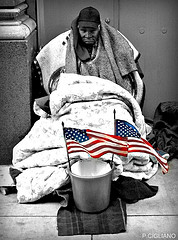 San Diego’s yearly Stand Down event just passed recently, hosted by one of the oldest and most well-known programs to help homeless veterans. In case you’re not familiar with it,
 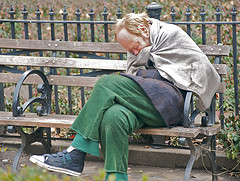 As you walk through the streets of San Diego, or any other American city, you will see the homeless. People living rough in the urban landscape. Each one is somebody’s brother, mother, son, cousin, or spouse. In addition, many of them had fought for our country.